

Some of you guys know but English is my second language. On top of that, I'm dyslexic and can't see typos to save my life. The invention of autocorrection basically allowed me to have any kind of career.
Of course I've always used tools like Grammarly — why wouldn't you? Great freemium product with a lot of smart moves up their sleeve. Today we'll look at one of them.
❝
And this is a two-parter: this week, what Grammarly absolutely nails. Next week, where the same flow completely falls apart, so stay tuned.
The Find
Grammarly — browser extension, writing assistant, lives wherever you type. I was working on some copy for clients this week when this popped up:
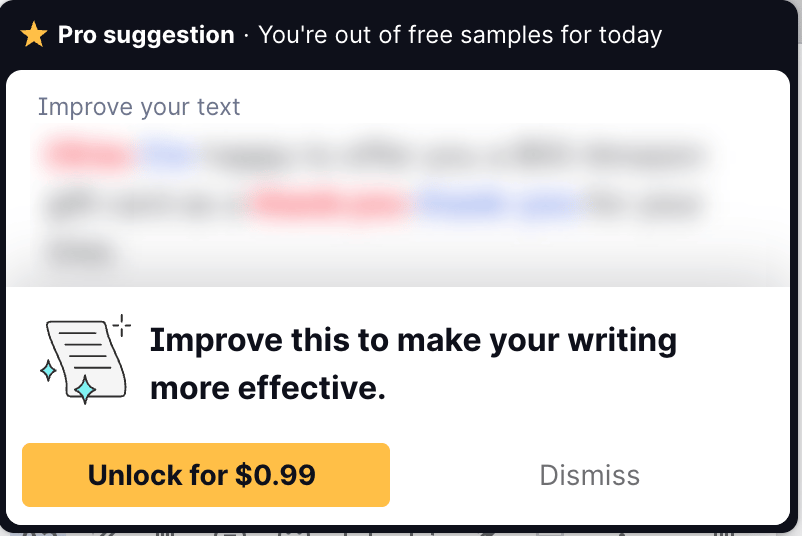
Three things jumped out.
1.It felt like a natural part of my workflow, not an external tool.
The upgrade prompt showed up right inside my writing — embedded in the exact spot where I was already working, when my attention was focused on the task.
2.I could see(ish) the result
The improved version of my text was right there — blurred, but kind of different from what I wrote. Not a feature list! A preview of my text, made better. One real value that I could almost touch.
3.Oh-so-low, $0.99.
Not $12/month. Not "start your free trial." A price so low it barely registers as a financial decision. More like buying a sticker than subscribing to software.
Most upgrade triggers yank you out of your flow, dump you on a pricing page, and ask you to evaluate a subscription. Grammarly's stays exactly where you are, shows real value, and then asks for pocket change.
When's the last time your product did that?
How Jennifer Aniston’s LolaVie brand grew sales 40% with CTV ads
The DTC beauty category is crowded. To break through, Jennifer Aniston’s brand LolaVie, worked with Roku Ads Manager to easily set up, test, and optimize CTV ad creatives. The campaign helped drive a big lift in sales and customer growth, helping LolaVie break through in the crowded beauty category.
Why It Works
The mechanism behind that blurred preview is mental ownership — and it's sneakier than it sounds.
Kahneman, Knetsch, and Thaler ran the classic version in 1990. They handed half the participants a coffee mug and asked everyone to trade. Mug owners wanted about $7 to sell. Buyers offered about $3. Same mug, same room, same moment. The only difference: one group had held it for a few minutes.
Peck and Shu took it further in 2009, publishing in the Journal of Consumer Research. They found that merely touching a product, even briefly, increased feelings of ownership and willingness to pay. Imagining touching it worked too. The brain doesn't wait for a receipt to start feeling like something is yours.
Grammarly's preview does this with text. You see your writing with improvements applied. Blurry, but obviously better. That preview creates pseudo-ownership — the improved version already feels like yours. Dismissing it means giving up something that already feels like yours. Loss aversion makes that harder than never seeing it at all.
The $0.99 removes the last objection. When the price is this low, the mental math collapses.
The Playbook
When to use it:
Products where users create, write, design, or build something, literally anywhere where the output is personal and visible. The more the user can see their own work improved (or have a feeling of that), the stronger the ownership trigger fires.
How to build it, three moves:
1. Place the trigger inside the value moment, not after it.
Grammarly doesn't wait for you to finish writing and then upsell from a settings page. The offer shows up while you're mid-sentence, staring at your own imperfect text. That's the moment desire is highest. For your product, map where users are most aware of the gap between what they have and what they could have, and put the upgrade there.
2. Show the user's own result improved, not a feature list.
A feature list says "you could have this." A preview of the user's actual work, upgraded, says "look, it's already done." Grammarly shows my text with corrections applied. That's a completely different psychological object than "access advanced grammar suggestions." One creates mental ownership. The other creates a menu. I'd push further here: Grammarly still blurs the whole result. Imagine showing just one correction clearly. The endowment effect would be even stronger.
3. Price the first step like it doesn't matter.
$0.99 isn't a subscription price. It's an impulse price. Grammarly treats the entry as a foot in the door: get past the first transaction, and the psychological barrier to a full subscription drops later. If your upgrade starts at $15/month, consider whether a one-time micro-purchase for a specific feature might convert the people who'd never click "subscribe." A trial still asks them to decide. A dollar asks them to barely notice.
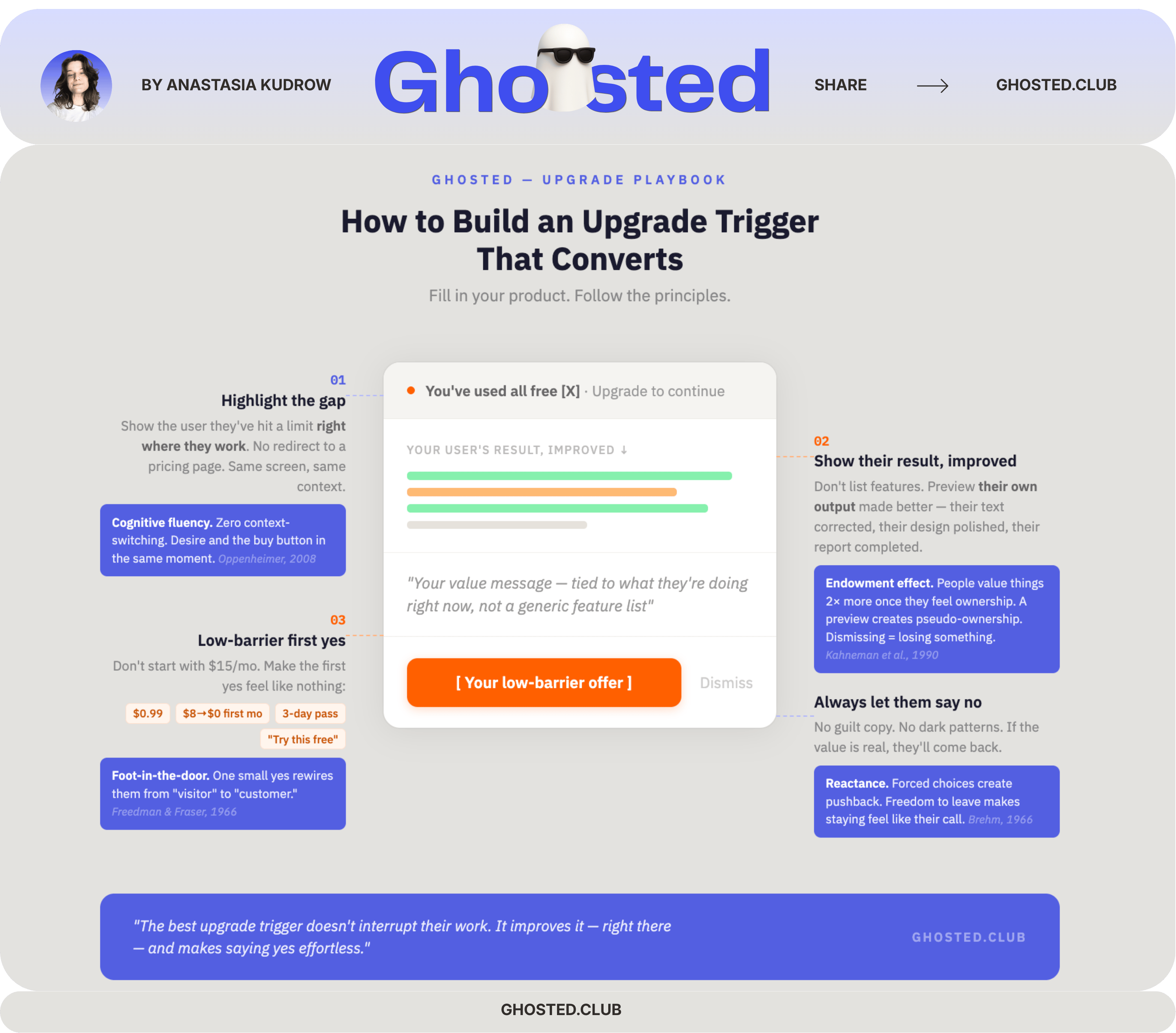
Want to design yourself? Save this ↓
When it backfires:
Products where the value is invisible: security, compliance, infrastructure. There's no "improved output" to preview, because there's nothing visual to show.
Better move: a usage report with reversed trial. Show users what the paid feature already did for them behind the scenes (threats blocked, errors caught, time saved), then offer the upgrade. Same principle, proof before payment, but a different medium.
If you forget everything, remember this:
The best upgrade trigger doesn't interrupt your user's work. It improves it, right there, in context, and charges so little that saying no feels harder than saying yes.
Next week in Part 2: what happens after you tap that $0.99 button, and why Grammarly's brilliant entry falls apart at the very next step.
🎉 Woow, you finished the issue, that’s awesome!
Hi, I’m Anastasia Kudrow, and I write Ghosted.
I am also a product growth consultant. I help SaaS teams apply psychology and PLG to build growth they can actually control. I run my own project, Growing Pains, and also work with one of the leading PLG consulting agencies, ProductLed, led by Wes Bush.
Feel free to follow me on LinkedIn:
https://www.linkedin.com/in/anastasia-kudrow/
Or check out my website, maybe we can work together: https://www.growingpains.consulting/
See you next week!