Hey everyone! We have a couple of changes today: a new day and a new format. If you have any feedback, just reply to this email and let me know how you like it! I’m honestly super curious and would love to know.
Okay, let's get straight into a heartbreaking truth of this week:
If people sign up to your free plan, it doesn't mean they understand what's in it. Most don't. Wow, right?
And if they don't know what they have before they start setting things up, they won't set things up, they won't engage, and they won't upgrade.
Let’s dive in.
The Find
I was going through Relay.app's onboarding last week. Relay is workflow automation (Zapier meets AI agents). Not a "sign up and go" product. You need to invest real time before you see any value.
During onboarding, before I'd connected a single app, one of the steps hit me with this:
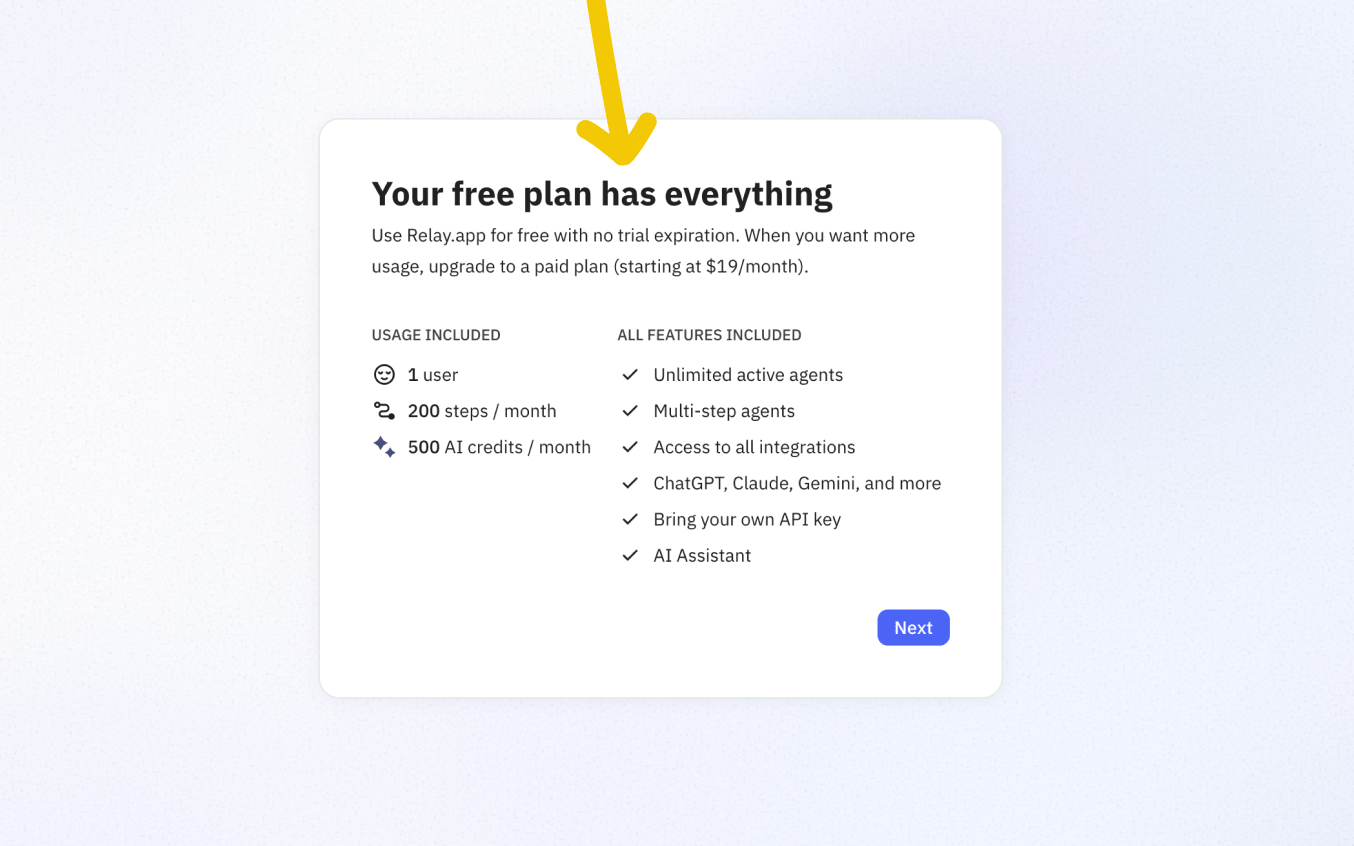
I keep signing up for freemium products, and I almost never see this. Most throw you into setup: "connect your CRM," "build your first workflow", without telling you what's actually included on free.
And here's the thing: most free users have never seen your pricing page. They saw "free," they signed up.
So the only place you can tell them what they have is inside the product, before they start doing anything.
Does your onboarding do that?

Why It Works
This is ambiguity aversion — yes, you've heard of it. But the application here goes beyond the usual paywall stuff.
In 1961, Ellsberg sat people down in front of two urns filled with colored balls. Pick an urn, draw a ball, get the right color, win money. Urn A had 50 red and 50 black and you could see the split. Urn B had 100 balls too, but nobody told you the ratio. The math works out the same. People overwhelmingly picked Urn A.
Most teams think about this at the pricing page. But the same bias hits at setup. When a user doesn't know what free includes, every onboarding step carries a background question: am I building something I won’t be able to use?
And this kills upgrades, not just engagement.
Nobody upgrades because they completed onboarding (I know, shocking, right?). They upgrade because they got a result they want to repeat.
But if the user wasn't sure the free tier would let them get there, they never invested in setup.
No setup, no result, no upgrade moment.
The Playbook
When to use it:
Products where setup is the bottleneck — integrations, workflows, anything that takes real effort before value. The higher the setup cost, the more your users need to know what they're working with before they start.
How to use it:
If your product passes the “when”, find a way to communicate these 3 things during onboarding.
1. Tell users whether the output is usable on free.
Users have been burned before. Build for free, but exporting or sharing the result? That's premium. If your free tier does let them use the output, say it. Explicitly. If users know upfront that free delivers a real, usable result, they'll invest in setup. That setup leads to value. That value leads to upgrades. If they're not sure, they won't start.
2. Show which features are included before they start building.
The user has a specific job in mind. Don't make them discover whether their integration or AI step is included by clicking into it and seeing a lock icon. List what's available upfront. Every hard paywall a user hits before they've experienced value is a paywall with zero context, the worst moment to ask for money.
3. Give context for the limits, not just numbers.
Relay shows "200 steps/month, 500 AI credits." Better than nothing. But 500 credits means nothing to someone who doesn't know what a "credit" costs. One line like "that's enough to run 10 workflows daily" turns a raw number into something the user can estimate against their real workload. Help them see that free covers enough to validate the product. Once they have that proof, wanting more is what drives the upgrade.
When it backfires:
If your free tier is thin (1 project, 1 feature, no integrations) communicating that upfront just scares people off. Great, no ambiguity. Also no users.
Better move: a reverse trial. Start them on paid, let them get the result, then downgrade. Now "upgrade" means "get back this specific thing you already use." Much stronger trigger than "imagine what you could do if you paid."
If you forget everything, remember this:
Nobody studies your product before starting for free. They just start. Your free tier needs the same communication effort as your paid plans. Because in PLG, the users who don't engage are the users who never upgrade.
🎉 Woow, you finished the issue, that’s awesome!
Hi, I’m Anastasia Kudrow, and I write Ghosted.
I am also a product growth consultant. I help SaaS teams apply psychology and PLG to build growth they can actually control. I run my own project, Growing Pains, and also work with one of the leading PLG consulting agencies, ProductLed, led by Wes Bush.
Feel free to follow me on LinkedIn:
https://www.linkedin.com/in/anastasia-kudrow/
Or check out my website, maybe we can work together: https://www.growingpains.consulting/
See you next week!