

Hey everyone! Quick one this week, but it’s been sitting with me for a while.
I’ve lost count of how many times a founder has told me their product can’t have guided onboarding. Too many use cases, too many features inside each use case, everyone shows up for something different. So how would you even pick a path for them?
And I get it, it’s a real problem. But the conclusion people draw from it is wrong.
Because what usually happens next is they show everyone the same empty product, hope people figure it out on their own. Also the word “explore” comes to mind, reminding us more of hunting in a jungle than solving a small task.
On top of that, trying to stay on top of all the possible ways to activate users in the product, teams build these complex PQLs that at the end make it impossible to understand what’s going on (especially when the product is young and you really need to find that successful path).
In all of this wonderful complexity, trying to accommodate everyone’s interests and feelings, we forget one thing:
Within the first session, all our users need is just to get started, not to implement an annual strategy.
THE FIND
Have you heard of Claude? It’s this… I’m kidding. You know what Claude is. I bet you also know that it's about the most horizontal product on earth. Literally anything you can type into it is a use case.
I started working with a new team this week, was joining their Claude with a new account, and saw this during the onboarding:
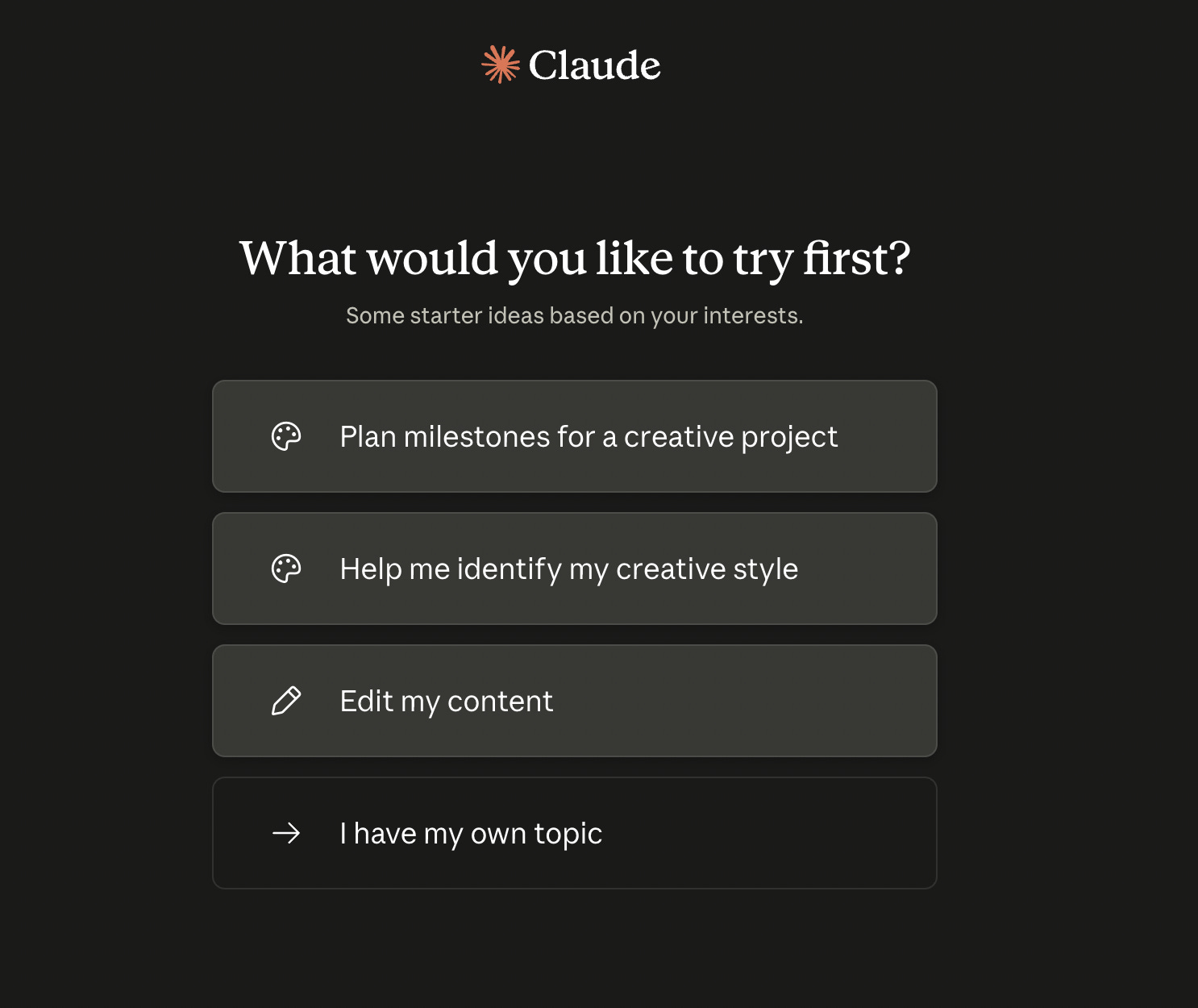
Before they asked me about my role and my interests (which was about me, not about the product, so I liked it more). But this is the first question about the product, and look how small and effortless it is.
The word doing all the work here is "first." And the subheading calls them starter ideas, which makes the whole thing feel like nothing. I'm picking what to do in the next few minutes, I'm not deciding anything about myself.
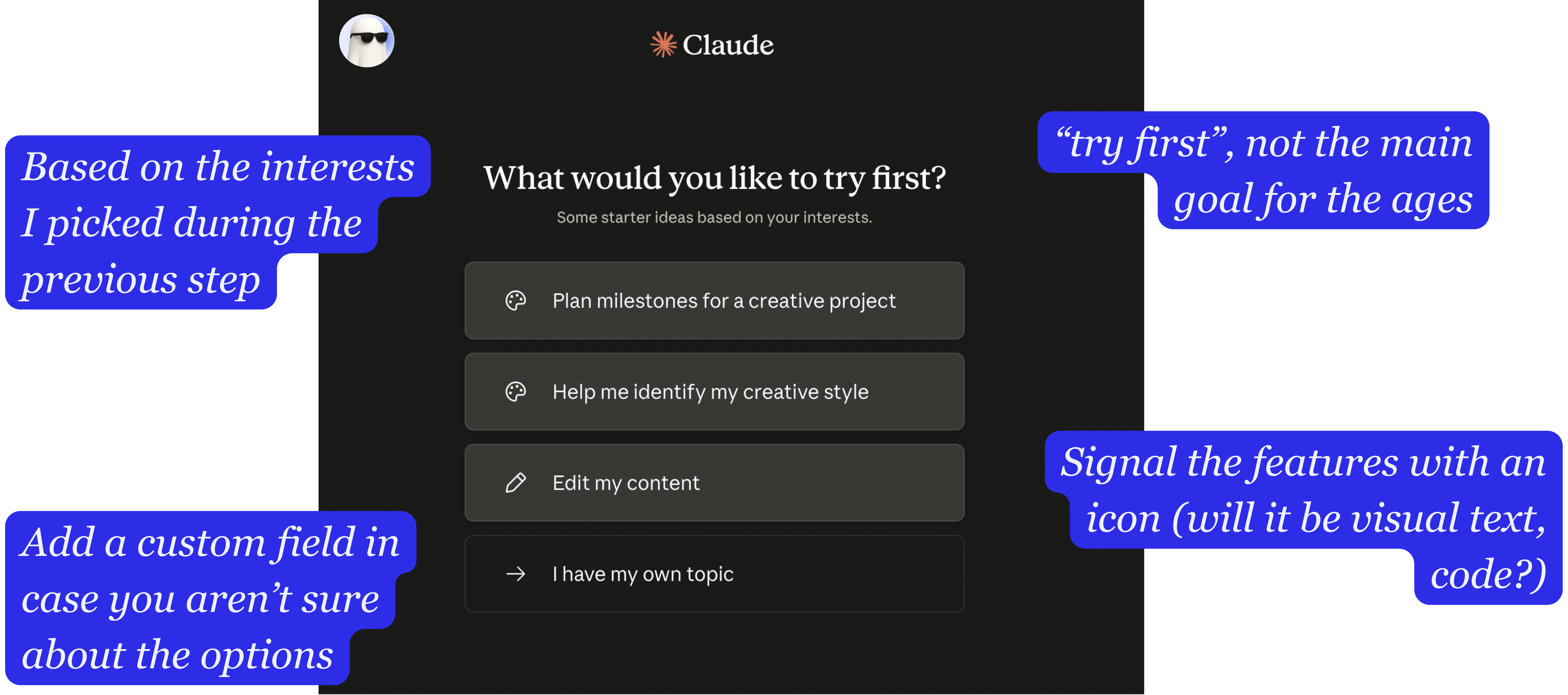
And that one step actually does the heavy lifting in your activation. Let’s see why.
WHY IT WORKS
Dear ambitious product people, you probably heard it from your therapists (I did), and you’ll hear it from me: small goals are always better. Because they actually get people working.
In 1981 some researchers took a group of kids who were struggling with maths and gave them all the same pile of material and seven sessions to get through it. One group was told to do six pages per session. Another group was told to do all forty-two by the end. A third group got no target at all.
The ones going session by session did clearly better on the test at the end. The ones aiming at the whole pile did about the same as the kids with no target whatsoever.
An overly ambitious goal performed like no goal at all, which I find kind of funny given how much of onboarding is built on asking people about their goals, but as you can see, not all the goals are created equal.
But to hell with the first session and onboarding; it goes further than that.
When those kids were later left alone with a bunch of things they could do, the ones who’d been hitting small targets went and picked maths on their own. Nobody made them. Finishing something small and seeing it work made them want more of it.
For our product-focused minds, it means that just one question can affect not only our first session and activation, but long-term engagement as well.
Someone who finished one real thing has proof the product works for them, and that proof is what makes them open the tab tomorrow. Someone who got handed the whole product and told to go achieve their goals ends the session with nothing except a vague feeling that they… khm.. failed.
And nobody upgrades after they failed. Nobody even stays.
THE PLAYBOOK
When to use it:
Any product where the first screen could go in ten different directions and all of them are fine. Automation tools, AI products, analytics, design tools, anything where you open it and there's no obvious single next step.
How to do it:
1. Ask where they want to start, not what their overall goal is.
“What do you want to try first” and “what will you use this for” look like the same question and they really aren’t. One of them a stranger can answer in two seconds. The other one makes them think about what their boss said, their end-of-the-year KPIs, and all that stuff they wrote in the strategy deck.
You get a better input out of it too. A starting point is something people actually know, because this is why they signed up. Even if it is “I need to see what it can do before I take it to my boss”, that’s a clear next step too.
2. Every option has to be finishable in one sitting.
“Plan milestones for a creative project” ends somewhere. “Explore integrations” doesn’t end anywhere, it’s the forty-two pages again with friendlier wording.
Think about it like joining a gym. If the guy at the front desk asks what your fitness goals are, you make something up on the spot and then don’t come back. If he says come in Tuesday at seven, we’re doing legs, you show up on Tuesday.
Remember and don’t lie to yourself: any, ANY task can be broken down into smaller steps.
3. Always let them type their own answer, and then actually go read those, group them, and add popular ones to options.
Anyone who skips your options and writes their own thing came in with something specific already in their head. That’s free positioning research, and an alignment check; don’t waste it.
Advanced step: feed the answer forward past onboarding. What they picked should decide the empty states, the checklist, the first week of emails, not just the first screen.
When it backfires:
When you ask and then do nothing with the answer.
Someone tells you they want to build a report, and you drop them on the same empty dashboard everybody else gets. Now they’ve got a stated goal, eleven tabs and no idea which one gets them there. Asking and then abandoning is worse than never asking, because users feel tricked and ignored.
So sort out the handoff before you ship the question. Best case: you pre-start the task for them (open the editor with the template already loaded, the workflow scaffolded, the first field filled in). If you can’t build that yet, at least land them on the right tab with a short checklist that matches what they picked. And if you can’t do either, hold the question until you can.
If you forget everything, remember this:
You don’t always need to know why someone signed up. You need them to finish one small thing today, because that’s what makes them come back tomorrow. Ask what they want to start with, keep it small enough to finish, and then go start it for them.
🎉 Woow, you finished the issue, that’s awesome!
Hi, I’m Anastasia Kudrow, and I write Ghosted.
I also help SaaS teams use psychology and PLG to build profitable products that people love using.
Come find me on LinkedIn: https://www.linkedin.com/in/anastasia-kudrow/
Or check out my site, maybe we end up working together:
https://www.ghosted.consulting/
See you next week!
Curious, have you recently signed up for any new tool? What was the worst or the best thing in the first session?