Hey everyone!
I want to spend the next few issues on referral programs, because I don't know a single team that hasn't struggled with one. They're a pain to build, the math gets risky fast, and after all the cash you hand out, referrals still tend to land as some embarrassingly small line on your revenue.
And yet everyone keeps building them, because when they actually work, it’s magic.
So I want to take them apart properly.
If there's a referral question that's been bugging you, drop it in the comments or just hit reply, and I'll work the good ones into the series.
Today, let’s start with the question underneath all the others: why won't people share?

The incentive isn't the engine
Most referral programs are built on a weird assumption: that people will harass their friends and colleagues, and look like a sleazy salesman doing it, all for ten dollars. They won't. The money was never going to be the reason, so when nobody shares, making the reward bigger almost never fixes it.
Think about what you're actually asking for.
Go to someone whose opinion of you matters and vouch for a product. That's a bet on your own reputation. When researchers look at why people recommend things at all, money sits near the bottom of the list.
We do it to help someone we like, and to look good doing it (!), to be the one who knew about the good thing first, yes, it’s all about ego, everyone has one. The trigger is internal, and a reward can't manufacture it.
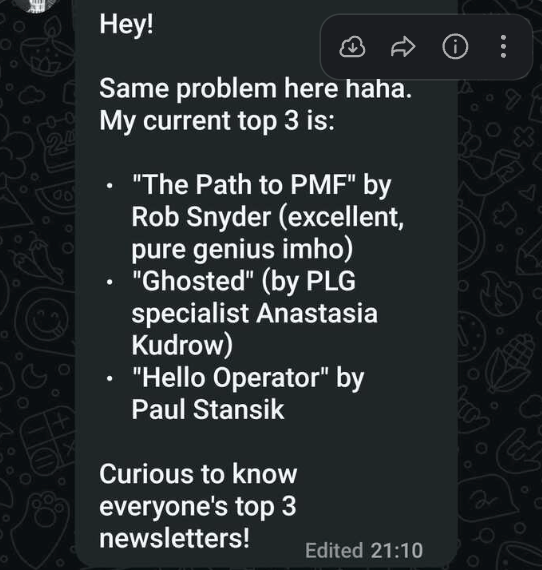
I see this from the other side all the time. I don't pay anyone to recommend Ghosted, so every time someone does it anyway, with nothing in it for them, it makes my whole day. But of course, I’ll come, like, and comment on it haha
Wait… are incentives useless?
Not really, even though we all could use a hot take for LinkedIn that something is dead again, right?
Seriously though, a referral program can absolutely have incentives, and a good one helps. You just have to be honest about the job it's doing.
But here’s the thing: the incentive doesn't make someone want to recommend you.
It lowers the friction once they already do. It's the nudge that gets a willing person to act today instead of next week, the little push to finally send the link they were already half-thinking about. It gives them a reason to do it now, and a reason to do it again. That's a real job, and it's worth designing well. It's just not the heavy lifting.
The wanting comes first, and the incentive rides on top of it. When the wanting isn't there, the incentive has nothing to work with, and it sits unused no matter how big you make it.
So the real question was never how much to pay (even though a “too small” cash incentive can absolutely hurt your flow). The real question is whether you've created the conditions where someone wants to share at all.
Okay, how to create those?
A referral only happens when a few things line up, and when they don't, no reward buys your way out.
1.The person has to actually love the product.
Not just "activated," but uses it and would be annoyed if it disappeared tomorrow. You can't vouch for something you've barely touched, and people won't. This is why emailing your whole user base a referral offer does so little. Most of them have nothing to vouch for yet, and a bigger reward won't hand them conviction they don't have.
2.They also have to know someone with the same problem.
Teams skip this one completely. A recommendation only makes sense between two people who share a need, the same job, the same headache, the same kind of work. If your user is a freelance designer, their referral is worth something to another freelance designer and nothing to their cousin who sells insurance. So your program leans on whether your best users run in circles full of more potential best users. When referrals stay flat, it's often not the reward, but the problem of who you are targeting (yes, at the very top of the funnel). Do they even have anyone to share it with?
3.And the ask has to make them look good, not you.
The second your program makes someone feel like your unpaid sales rep, you lose the exact people you wanted. Dropbox got this right, and we all can’t stop talking about it. Their referral line wasn't "earn by sharing," it was "get more space." Same action, but one makes the user your salesman and the other makes them someone getting more value from the product they already love and sharing the same with a friend.
But even when those are in place, you can fail, if…
… you simply forget to inform me that this opportunity exists. Sorry for this official tone, but I really wanted to highlight how serious this dumb problem is.
We ran a regular research with one of my clients to figure out why our referral program didn’t perform as well as we’d like. We bet that the offer wasn’t good enough. Turned out, 60%+ of users never even heard about it.
Placement does more work here than the size of the reward, especially if you have a high-volume product.
A referral link tucked in a settings menu gets close to zero use; the same link on the main screen gets 30%+. One Shopify brand tested it and watched participation climb from 0.8% with a footer link, to 4.2% with a dashboard embed, to 11.7% with an in-product prompt that fired at the right moment. That's a 14x swing from placement and timing alone, before you touch the reward.
So, two things:
Where it lives: put it in the path people already walk, the dashboard, the onboarding flow, the screen they land on after they get a result. Don’t make it annoying but make it present.
And when it fires: ask right after a win, not at signup before they've felt anything. The moment someone finishes a project, sends the first invoice, hits the result they came for, that's when they feel good about you and will actually pass it on.
3 things to make people want to share your product
1. Pick the segment before the reward.
Start with people who love the product and know others with the same problem. If those two things aren't true, no incentive saves you, because you're paying people to do something they have no reason to do.
2. Make it visible at the moment of value.
Put the ask in the path they already walk, and trigger it right after a win. A referral link nobody sees is the most common reason a program looks dead, and no reward fixes a link nobody finds.
3. Treat the reward as a nudge, not the main point.
It smooths a trigger that's already there, but a great experience and product adoption must come first. So when referrals are flat, don't reach for a bigger number. Go back and check the conditions and the placement first.
If you forget everything, remember this:
You can't pay someone enough to feel good about selling out their friends. If users don’t share your product, look into segmentation, exposure, and overall client satisfaction. If those components don’t work, a bigger offer won't change it.
🎉 Woow, you finished the issue, that’s awesome!
Hi, I’m Anastasia Kudrow, and I write Ghosted.
I also help SaaS teams get more upgrades by using psychology instead of cheap tricks. Because hype aside, people will be buying your product for many more years, AI or not AI.