

Hey everyone! I was preparing a presentation this week for the TinySeed incubator and found a great example of the balance between AI chat and goal-driven onboarding.
If you are designing an agent journey in the product right now or thinking about adding AI features, I think it will be a good one. Let’s dive in.
THE CHALLENGE
I have a sense that whenever the conversation about AI pops up, teams are paralyzed; it feels like you have to rebuild your whole product approach to fit under this AI wrapper, and there’s no other way around it.
For a second, everyone pretends AI cancels the fear of a white canvas because, instead of being paralyzed, we can ask whatever we need of a mighty machine.
However, over years of working with product and human behavior, I’m certain of one thing: people often don’t know what they need, and they seek the tool/solution/outside expertise to help them understand where to start.
So, the challenge right now is: should we minimize our onboarding to one AI chat? And is it always a good idea?
THE GAP
Back in 2001, researchers in Sydney taught 24 apprentices a skill none of them had tried before: writing simple programs for factory machines.
Then they split them into two groups. Both groups got the same list of tasks.
Group A had to work out every task on their own.
Group B got every other task already done, with each step shown. So they could read the finished one, then try the next one themselves.
Which group did better?
Group B.
After a week of training, the people who saw finished examples scored about twice as high as the people who did everything on their own.
Then the researchers kept training everyone until they knew the basics. They moved them to a similar skill and split them into the same two kinds of groups again. And this time it flipped. The people working from scratch did better, and the ones getting finished examples made more mistakes.
So, what do we get from this?
When you are new, a finished example shows you what a good answer looks like. Once you know that, the example is just extra reading that gets in your way. It is an experience gap that we need to bridge correctly, demanding just the right amount of effort for the expected result.
And here’s where open-ended AI chat might be a problem.
It works great for the person in week two, who already knows what good looks like. But not every user who comes to our product is an expert in the field. Many don’t have a clear picture of what they want to achieve, or even where they want to start. For them, an empty chat box is Group A: every task from scratch, with no finished example to learn from.
HOW TO WORK WITH IT
I’m thinking about starting outreach, which I never did before, and it’s new to me. There’s a reason I do PLG; I’m not a big fan of sales haha. But I love learning new skills and wanted to give Apollo a try.
And I loooved their onboarding.
Here, right after signup, they gave me a short AI magic: a short business profile based on my domain. I didn’t even have to drop my website in, they just scraped it from my email and provided a summary of what kind of customers I might be serving.
Then they still asked me to pick one problem I want to start with.
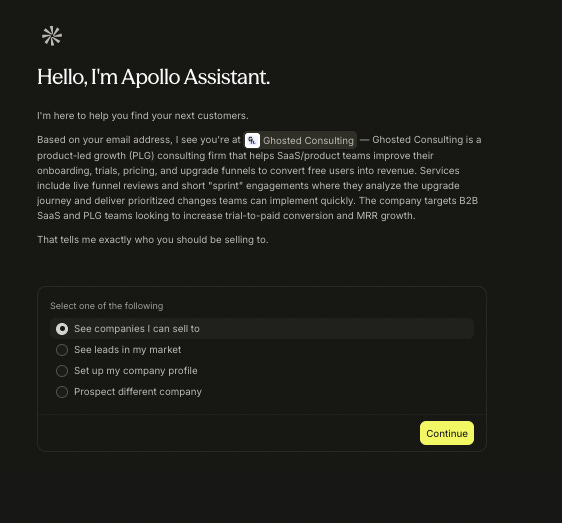
After that, they showed me the magic of an AI-driven tool that collected potential customers for me and rated them, so I knew where to start again and didn’t get overwhelmed.
I especially loved how the chat highlighted the next steps with a recommended option. It was a guided conversation, not just an empty field.

Why I loved it: I didn’t know where to start; I was that beginner who would struggle to type anything into AI chat besides: find me clients, make no mistakes. They showed me what my profile looks like, helped me pick a priority, and then focused me on the task, while still leaving the opportunity for chatting open.
This closed my expectation gap perfectly and still left the space for someone more experienced who would love to navigate the waters more independently.
ONE THING TO REMEMBER
AI doesn’t cancel basic principles; we just need to find the right stages it can enhance without pretending it completely changed how people have behaved for hundreds of years.