

I counted yesterday that Ghosted accumulated 55 issues. Wow. In most of them, I was exploring ways to keep people in your product, but today I want to talk about a different case.
How to get back someone we already lost?
Because every product loses users. And it’s actually completely normal. But churn comes in many shapes, and not all of them are hopeless if we approach it the right way.
THE CHALLENGE
Every product gets to reactivation eventually, because nobody’s churn is getting smaller, and least of all in AI products. And when we get there, the whole thing tends to land on lifecycle marketing, whose job is to earn the click and find the trigger that brings people back.
Somewhere along the way we decide that getting them back into the product is enough, and that they’ll figure out the rest from there, because after all they’ve used this before.
So we pretend they never left and drop them right where they stopped the last time. At a half-created project, mid-way integration, unfinished design, etc. We even lead with it in the email, because they made that thing and people care about things they made, and asking them to redo the setup they already started a year ago would be insulting.
But what happens to most of them after they log in?
They leave.
Again.
And that is why reactivation campaigns often have bad rep.
Even when the campaign works and people click, the ones who come back tend to activate worse and pay worse than someone who’d never heard of you. Which is strange, because these are the cheapest users you will ever address. You already paid to acquire them and they already understand what you do.
So, why can’t we meet their expectations by dropping them right where they left off?
THE GAP
Here’s the thing about a reactivated user: you kind of acquire them twice. If we are talking about big breaks in usage, which is my main focus in this issue, 2 complitely different triggers could have brought the same user to your product the first time and the second time.
Imagine.
You were building a website in Canva last year, then the project got deprioritized, and you forgot about it, didn’t have another design task for a long time. Today you’re back because you saw the new poster templates somewhere in an Instagram ad and decided that you want to try it. But after logging in, you are being dropped back into your messy, half-baked website flow and have to dig yourself out of that situation, find the poster flow, find the right template, etc.
For this case, it’s almost worse than doing nothing, because now you are being forced into something that isn’t relevant to you, and honestly? You wouldn’t have picked this path if you were given a choice.
There’s a study from 1978 where people were organized in pairs to do puzzles. The first person in each pair chose which three puzzles they wanted and decided how many minutes to give each one.
The second person got handed three puzzles and told how long to spend, and it was the exact same three their partner had chosen, for the exact same minutes. So both of them sat there doing identical work, and the only thing separating them was that one had decided it and the other had been told.
Then the researcher announced the experiment was over and walked out, leaving the puzzles on the table with nobody watching.
You know where I’m going with this, right?
The people who had chosen went back to the puzzles in that empty room, and when they were asked whether they’d want to come and do this again another day, they said yes far more often than the partners who’d been handed the identical thing.
So when we automatically force “reactivated” (by that I mean actually just “relogged”) users into their old setup, we're kind of picking the puzzle for them and making the expectation gap as large as the Grand Canyon. And I’m not saying that this journey is fundamentally wrong. If the goal remains the same, there are true benefits to it.
The good news is: instead of assuming something by default, we can always ask.
HOW TO CLOSE IT
I love love love how Duolingo does it, so let’s just steal it. These 3 steps can be adjusted to your product of course, they are pretty simple and do help you truly reactivate users who are coming back after a long break.
1. Tell me you noticed.
Come back after a long absence and the first thing the owl does is say it knows who you are and that you’ve been gone. It costs nothing and it asks nothing, and it lands, because it’s like walking into a bar where everybody knows your name.


2. Ask what I’m here for today before you decide for me.
Then it asks. Keep going with German, take a different course, or try the brand new chess thing. Which matters, because who knows what actually brought me back? It could have been an ad about a new feature, an upcoming trip, or a major change in my life, and any one of those could point somewhere other than where I stopped.
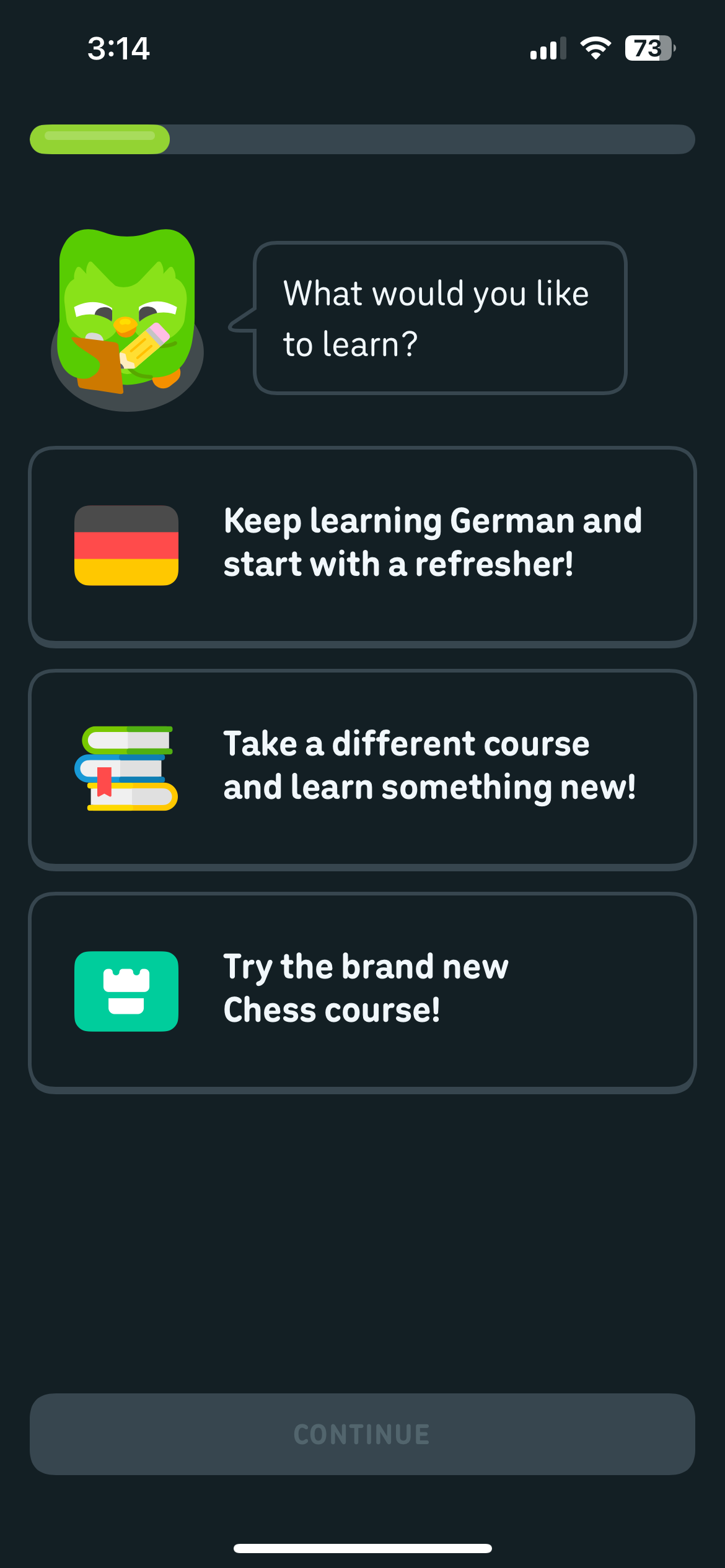
3. Update the context.
Once I’ve said German it asks how much I still remember, why I’m learning (now), and then builds a starting point out of those answers rather than out of the one I abandoned. Instead of returning me to my old plan, it’s making a new one for the person I am today.


If you’re B2B and this feels very consumer, the translation is not complicated. Ask whether they’re rejoining an old team or starting a new one. Ask whether they’re picking up the old project or beginning something else. Show them what changed while they were away. Keep what they built but clarify the context.
None of this applies if they’ve only been gone a fortnight, and it can be modified if they told you why they came before logging in. My point is the same as always: our product plays a very small role in our users’ lives and exists within the context of specific tasks. Without knowing it, we can’t provide value as well as we’d like and meet their expectations, which only keep growing.
ONE THING TO REMEMBER
Life happens between when somebody left and when they came back, and the setup they left behind was built for a version of them that has already expired. Make them feel welcome and put them on the track that makes sense today.