

Hey everyone, I hope you’re all enjoying the Fall, wherever you are. This is my absolute favorite season. And I have to say that it is incredibly difficult to make myself productive, because all I want to do all day is play tennis in the park and enjoy the leaves that just started turning.

But this Friday I did a great job of putting myself to write this issue, because I think there is one concern we need to address.
THE CHALLENGE
A couple of weeks ago I was doing a workshop for early-stage founders. And one of the things I kept hearing was that everyone is very concerned with AI spending. Specifically, how much the AI credits on the free tier will cost them.
This is the conflict between generative AI products and PLG. PLG says let people in and let them try the product for free. But teams are afraid to open up the experience for free, because every try costs them. So they cut it and put hard caps, trying not to go bankrupt.
But too often, our determination to control everything leads to a place where users just cannot get enough value. We limit the free credits so much that people can’t actually explore the product at all because they need not just enough credits to get to the value, but also — to make some mistakes on the way.
You can argue with me, especially if you are a bootstrapped startup: hey, Anastasia, you cannot not be mindful about this stuff.
And I absolutely get you.
So the question is, how do we get the most value out of every free credit? And is it that crucial for our growth?
THE GAP
When it comes to AI, the effort is very low. It doesn’t take me a lot of time to get something. Usually I just press a button or I send a very short text.
What I judge is the result.
And if it’s not good enough, it’s not good enough. I don’t think, oh, maybe I didn’t have enough credits. As a new user who’s just developing trust in a product and deciding whether to stick with you, I don’t analyze the circumstances. I judge your whole product by the output I got.
There’s a study that shows how much those first results decide.
Researchers gave 111 people an AI that labelled 40 photos of insects. The AI was right 19 times out of 40. Everyone saw the same labels. Half saw the correct ones first. The other half saw the mistakes first.
So who trusted the AI less?
People who knew insects and saw the mistakes first. When the AI got better later, their trust barely moved, and 11 of 27 said they never trusted it at all. People who didn’t know insects trusted the AI either way. They couldn’t tell a right label from a wrong one.
Your users are the insect experts. They know what a good result looks like (or they think they know) in their own work. If the first results are bad, they won’t wait for the good ones, especially when the credits run out before they get there.
HOW TO WORK WITH IT
1. Give people more credits at the start than later
New users need room to play. Their first sessions are trial and error, and they need several tries before something works. Regular users already know what they want, so they need less.
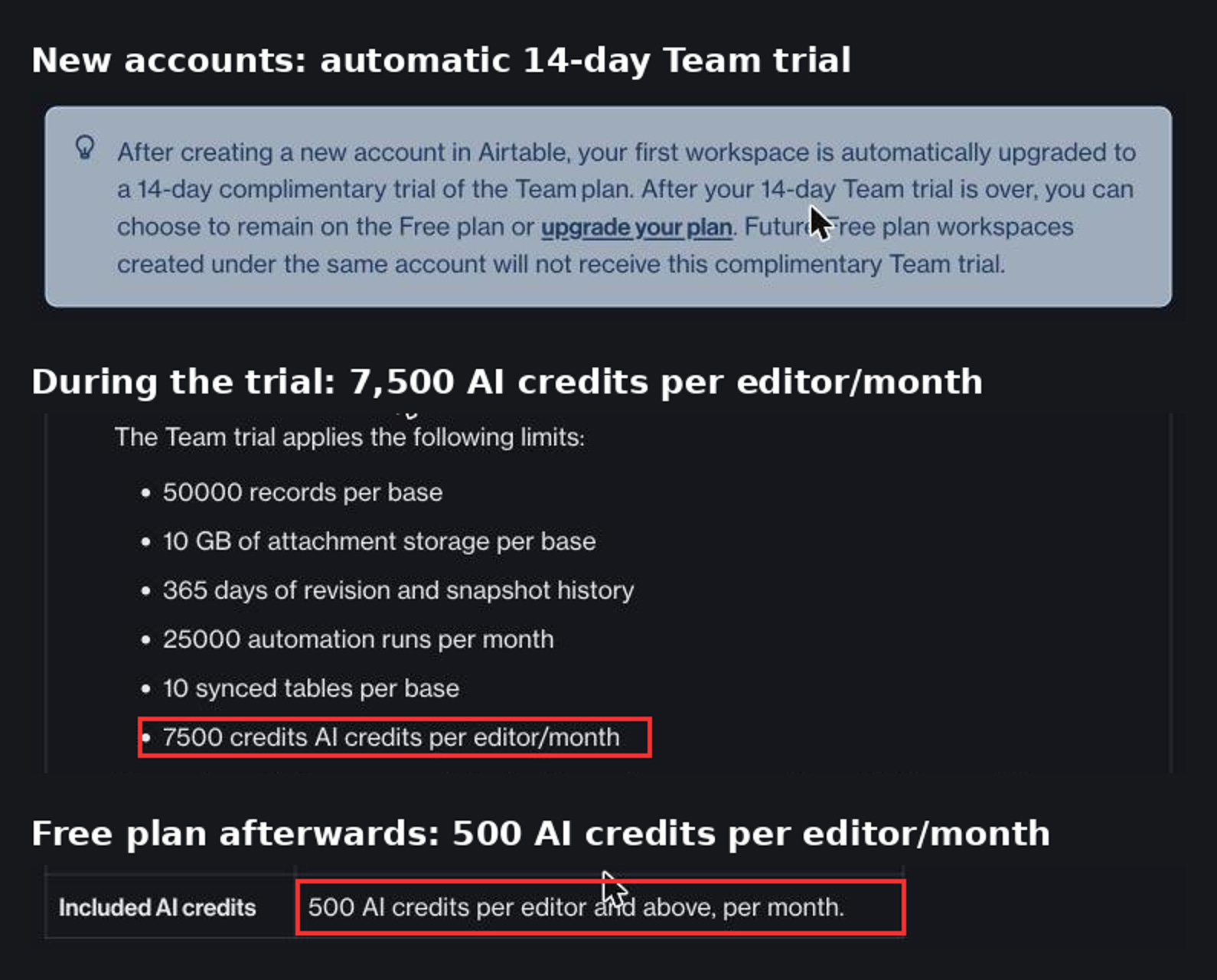
Airtable does exactly this. When you sign up, you get a 14-day Team trial with 7,500 AI credits per editor per month. After the trial, you go to the Free plan with 500. So you get fifteen times more credits right when you’re figuring the product out.
2. Let me test on a small sample first
Many AI products run every new action on all your data at once. That goes wrong in two ways.
If I set something up wrong, one try eats a big part of my free credits, and the only result I see is a bad one.
Or my data set is huge, the credits run out halfway, and I get no output at all, or just a few rows, because most of the credits went into processing.
Clay lets you test first. In Clay, you paste a list of companies, like your potential B2B clients, and Clay finds information about each one, for example how many employees they have. You pay credits for every company. Before you run anything, Clay lets you choose how many rows to run. So you can try it on five companies, check the answers, fix your setup, and only then run it on all five hundred.
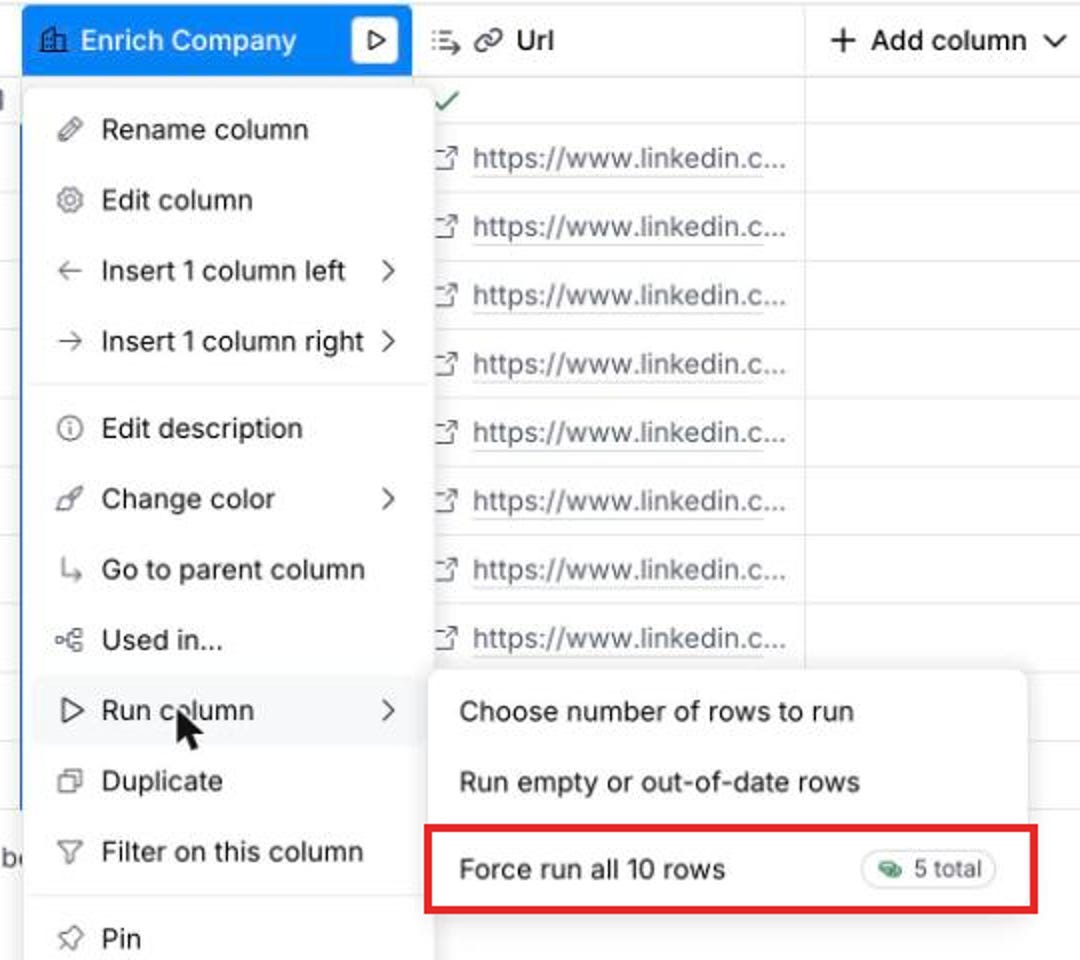
Now my first try costs a few credits instead of the whole allowance, and I actually see a finished result. If it’s good, I know the product works. If it’s not, I still have credits left to fix it and try again.
ONE THING TO REMEMBER
New users need more room than regular users, because their first sessions are trial and error. Give them more at the start, and design the product so each credit shows as much of it as possible.