Hey everyone! I keep seeing a new narrative forming in the growth community. For years, everyone only talked about activation. Get users to that first value moment as fast as possible. And it is important.
But people are finally starting to talk about what comes after: the habit.
I think it's about time, because activation doesn't always bring you upgrades. Habit and long-term engagement do. And I see this constantly with my clients. This week was a perfect example: a client with a very strong top of funnel. Dedicated, curious audience that was actively looking for guidance. Barely anyone came back after the first session. Barely anyone upgraded without a demo.
The early value wasn't great either, but that wasn't the main problem. The main problem was habit building. Introducing the core features. Getting people to actually adopt them. This is one of the biggest challenges I see, especially with more complex B2B tools.
How do you form a habit that drives long-term revenue? And why are the rules so different from how we work with activation?
Want to read issues that solve your current challenges? 👇
submit a product you are curious about
The Find
I heavily use Magic Patterns. I honestly think it's the most convenient product for collaborative design and prototyping, especially for consultants who work across multiple client projects.
The other day when I opened the product, I saw this:
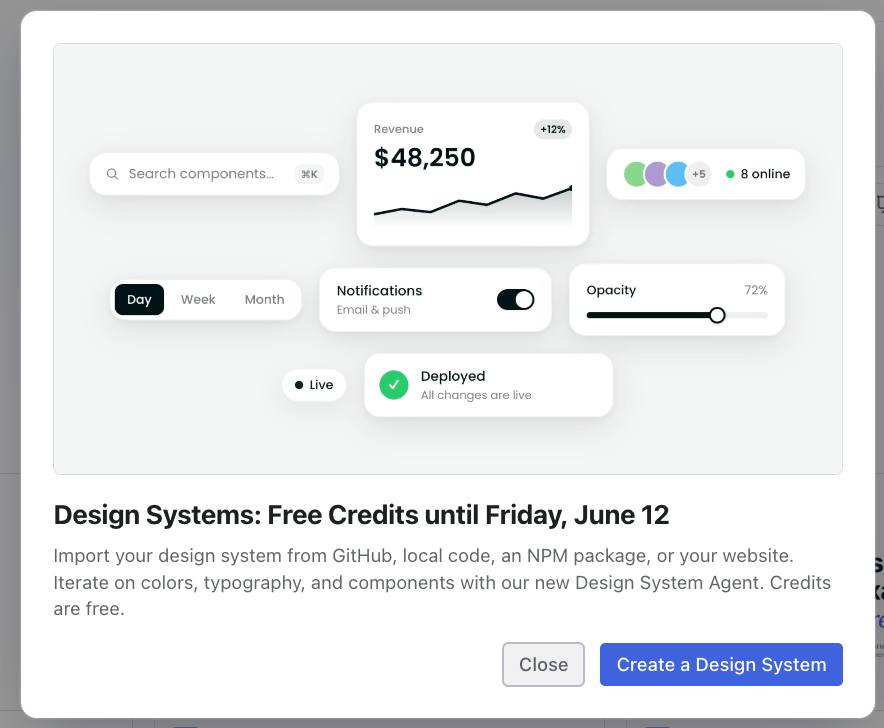
A suggestion to create a design system, with free credits gifted to me to accomplish this task.
Here's why I think this is genius for habit formation.
It specifically prompts an activated user to do a task that will signify a bigger commitment, improve the overall quality of their results, and create a sense of ownership over what they've built.
On top of that, it reduces the barrier. Creating a design system sounds like homework, but Magic Patterns invested in me so I could do it. Free credits, on them. Just go and do it, you will benefit from it, and the product will benefit from it too.
Now, I can see how this contradicts the activation logic that many people use. When we think about activation, we're trying to cut as much as we can. Reduce the number of steps, postpone the most complicated tasks. But big results don't come from small moves. You have to invest to actually feel dedicated. And when it comes to habit, it does make sense to onboard users into heavier use cases that contribute to long-term engagement and the overall experience from the product.
Why it works: psychology behind
Think about the last product you kept coming back to. The one where, at some point, you built something inside it. You uploaded your data. You configured your workspace. You set up templates that saved you time every week. You committed.
Now think about whether you'd switch to a competitor. Probably not. And the reason isn't that the competitor is worse. It's that you already put work in. You'd have to redo all of it. That feeling of "I've already invested too much to leave" is doing more for your retention than any activation flow ever could.
Norton, Mochon, and Ariely studied this in 2012. They had people assemble IKEA boxes, fold origami, and build Lego sets. Participants consistently overvalued their own creations, rating their wobbly origami cranes nearly as high as expert-made ones. The researchers called it the IKEA effect: when you put labor into something, you value it more. You probably know that.
But there's a critical boundary condition.
The effect only kicked in when participants successfully completed the task. When they built something and then had to destroy it, or couldn't finish, the increased valuation disappeared entirely.
This is exactly what Magic Patterns is engineering.
A design system is meaningful labor. You're importing your brand, your components, your typography. When you finish, you've built something inside the product that's yours. You value it. You don't want to walk away from it.
Nir Eyal calls this the investment phase, the most overlooked step in his Hook Model. Users put something into the product that stores value for future use. Data, content, configurations. The more you invest, the more the product appreciates for you specifically, and the harder it becomes to switch. Your design system now lives in Magic Patterns. Every future generation matches your brand. Leaving would mean rebuilding all of that somewhere else.
The free credits solve the boundary condition problem. Creating a design system sounds like homework. Credits reframe it from "work you should probably do" to "a gift you'd be silly to waste."
The Playbook
When to keep it in mind:
This move is for users who've already gotten some value from your product. They've used it, they've seen what it can do. If your setup and even activation look reasonable, but there are barely any self-serve upgrades after the trial, this is for you.
How to use it:
1. Find the investment action that raises switching costs.
Look for the task that, once completed, makes your product personalized in a way that's painful to replicate elsewhere. For Magic Patterns, it's the design system. For a project management tool, it could be importing your team's workflow templates. For an analytics platform, setting up custom dashboards / integrating with Slack or Notion. The key is that the action should produce something the user will reference repeatedly.
2. Subsidize the effort.
This is where most products fail. They know the deeper feature exists. They even nudge users toward it. But they treat it like any other feature adoption message: "hey, have you tried this?" Magic Patterns gave me free credits. They put skin in the game. Think about what your version of that looks like. Extended trial access to the feature, a free migration service, a setup wizard that cuts the manual work in half. The goal is to get users past the finish line, because the IKEA effect research is very clear on this: incomplete investment creates zero additional attachment. People need to finish the task for the magic to work.
3.Time the prompt to a moment of momentum.
Magic Patterns showed me this when I opened the product, when I was already in work mode, already engaged, already likely to say yes. Don't bury the investment prompt in an onboarding email three days after signup when the user has already mentally moved on. Show it when they're in the product, doing things, riding the energy of something they just accomplished.
When it backfires:
If your users haven't hit initial value yet, asking them to invest deeper feels like you're piling homework on top of homework. You're essentially asking someone to furnish a house they haven't decided to rent. I see this a lot with B2B tools that rush users into complex setup flows before anyone has seen a single result. If activation metrics are still weak, fix that first. Pushing investment too early accelerates churn.
Better move here: focus on a time-to-value sprint. Strip the first session down to one clear result. Then introduce the investment play on return visit two or three, when they've already decided the product does something useful for them.
If you forget everything, remember this:
Activation gets users in the door. But it's investment that makes them stay. The products with the strongest long-term retention are the ones that get you to build something inside them you don't want to leave behind. And the smartest ones make that building feel like a gift, not a chore.
🎉 Woow, you finished the issue, that’s awesome!
Hi, I’m Anastasia Kudrow, and I write Ghosted.
I also help SaaS teams get more upgrades by using psychology instead of cheap tricks. Because hype aside, people will be buying your product for many more years, AI or not AI.